








Home
Games
Microsoft FreeCell Solitaire
Find out how playing cards by yourself using strategy and puzzle solving can be so addictive.
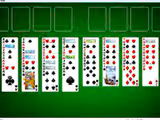
Manipulate the cards placed atop each other on the eight card columns to get to the card you sequentially need in order to complete the four suite stack at the upper right by following the rules of the game.
Use the four available free slots at the top left wisely when moving the cards below around. Think of them as temporary buffers where you can place a card (and take it out) as a way to reach the cards that you need that are stacked up below by the other cards in the lower columns.
“And Solitaire's the only game in town” ...As Karen Carpenter used to sing and quite an apt description of what Solitaire is, prior to even becoming a single player card game. Solitaire in it's simplest terms means by one self, alone and isolated. Anything or anyone who fits this description is considered a Solitaire. The game on the other hand was said to have been invented by a French Nobleman in the 17th Century who was imprisoned under the rule of King Louis XIV. Solitaire the game was also generally known as "Patience" (no, not that Bon Jovi song with the same name), and has a number of versions which where created through the years. The first official compiled description of the game was written by Lady Adelaide Cadogan with her "Illustrated Games of Patience" printed around 1870 as well as reprinted a number of times with no other known literature on the game prior to her work. Her book then spawned a number of following works from other writers and authorities on the single player game.
The popularity of Solitaire as a card game has become a regular activity from it's initial inception in history to our current day today. Also, unlike in the distant past when a deck of playing cards where both costly and hard to come by, regular standard playing cards can be easily purchased nowadays. Playing Solitaire in whatever version one chooses to do so is a challenging and rewarding experience. With the common everyday availability of digital devices nowadays, you can play the game with your computer, tablet or phone and when you learn how to play it, you will discover how immersive and addictive a simple deck of cards can be.
FreeCell Solitaire is a version of Solitaire that uses a standard 52-card deck. It was created by Paul Alfille by referencing to another Solitaire version called Baker's Game to create his variation. The main difference with most Solitaire games is that the cards are all facing upward so you can see them which shits the game greatly from a game of chance to puzzle solving and strategy. Alfille's version was called FreeCell and is actually one of the most winnable versions to play. Paul Alfille first created the game using regular deck cards as he was interested in the mathematical outcome the moves in the game could achieve. While studying at the University of Illinois in the 1960's, he ported the game over to a Mainframe computer for the PLATO educational computer system created for and used by the University during the time. FreeCell as a computer card game since then, has risen to such popularity that it was included by Microsoft as one of the games for its Windows PC operating system. If you're still using Win 7 today, just check your Windows games and you'll find FreeCell there.
The game is arranged shuffling the entire 52 cards into a layout of eight columns. Above the cards are another eight slots divided with four each to the left and right. The left four slots are your temporary holding buffers so you can move your cards around. The objective is to fill up the right most four slots with each card of the four suites ( Ace, Heart, Club and Diamond) on top of each other. You have some major rules going for you though. First, you have to fill each four suite card stack in order starting from Ace then 2,3,to 10 then Jack, Queen and King on the very top of the stack. You do this by pulling out the cards from their layout position below and placing them on the stacks accordingly. If the stack is already at Diamond 4 then you have to pull out a Diamond 5 and stack it on top.
Pulling out the cards from below the card columns is what's complicated. The card you need, Diamond 6 is under several other cards. To get to that 6 you have to manipulate or transfer cards around but you can only do that by placing a lower valued card in sequence atop another and using the other color. You have two card colors, Red and Black (or whatever variation). A card which is at the bottom of the column and is a Red 5 of Hearts can only have another card in whichever suite (Ace, Club and Diamond) which is a 4 and colored black placed on top of it. This will give you the ability to move the cards around so you can get to the card you have to free, in this case the Diamond 6 so you can add it to the Diamond stack at the top.
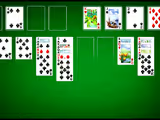
Note importantly that you have four blank buffer slots at the top left. You can put cards there so you can get to the card you need but be advised, once you put a card there, you can only put it back with the cards below if there is a card at the bottom with an opposite color one point higher than it. Also, you can shift it to the appropriate stack of four on the right when it has it's turn to fill the slot. If you end up filling those four buffers, you might find it very difficult to maneuver your cards below, so you have to be careful to fill those buffers only when you feel it absolutely to do so. One more thing, if the cards in a column below have all been moved and becomes blank, you can use it as a one time buffer and place a card or card group there. A card group is when a set of cards end up in descending order with the correct alternating colors. If you have a 10,9 and 8 with alternating colors with the 8 at the bottom, you can move all 3 cards as a group.
It's kind of a bit complicated if you're just beginning to play the game and may take several tries to get the gist of it, but when you get how the game is played, time will move on without you realizing it. FreeCell is a really fun game to play even for someone like me who rarely plays card games. It is addictive and has that Dopamine "One More Round" temptation to it as it challenges your thinking and observation skills and how you will manipulate the cards to get the suite stacks above filled up. Once you have the Four Kings at the top right, you win the game. Just make sure you really have the time to spend if you're going to play this game because, as Karen points out in her song ... “While life goes on around him everywhere, he's playing solitaire ...“
Microsoft FreeCell Summary
 Games Like Microsoft FreeCell


-
Rate
0 Votes
75
Played Play Now!
Played Play Now!
Find out how playing cards by yourself using strategy and puzzle solving can be so addictive.
Manipulate the cards placed atop each other on the eight card columns to get to the card you sequentially need in order to complete the four suite stack at the upper right by following the rules of the game.
Use the four available free slots at the top left wisely when moving the cards below around. Think of them as temporary buffers where you can place a card (and take it out) as a way to reach the cards that you need that are stacked up below by the other cards in the lower columns.
“And Solitaire's the only game in town” ...As Karen Carpenter used to sing and quite an apt description of what Solitaire is, prior to even becoming a single player card game. Solitaire in it's simplest terms means by one self, alone and isolated. Anything or anyone who fits this description is considered a Solitaire. The game on the other hand was said to have been invented by a French Nobleman in the 17th Century who was imprisoned under the rule of King Louis XIV. Solitaire the game was also generally known as "Patience" (no, not that Bon Jovi song with the same name), and has a number of versions which where created through the years. The first official compiled description of the game was written by Lady Adelaide Cadogan with her "Illustrated Games of Patience" printed around 1870 as well as reprinted a number of times with no other known literature on the game prior to her work. Her book then spawned a number of following works from other writers and authorities on the single player game.
The popularity of Solitaire as a card game has become a regular activity from it's initial inception in history to our current day today. Also, unlike in the distant past when a deck of playing cards where both costly and hard to come by, regular standard playing cards can be easily purchased nowadays. Playing Solitaire in whatever version one chooses to do so is a challenging and rewarding experience. With the common everyday availability of digital devices nowadays, you can play the game with your computer, tablet or phone and when you learn how to play it, you will discover how immersive and addictive a simple deck of cards can be.
FreeCell Solitaire is a version of Solitaire that uses a standard 52-card deck. It was created by Paul Alfille by referencing to another Solitaire version called Baker's Game to create his variation. The main difference with most Solitaire games is that the cards are all facing upward so you can see them which shits the game greatly from a game of chance to puzzle solving and strategy. Alfille's version was called FreeCell and is actually one of the most winnable versions to play. Paul Alfille first created the game using regular deck cards as he was interested in the mathematical outcome the moves in the game could achieve. While studying at the University of Illinois in the 1960's, he ported the game over to a Mainframe computer for the PLATO educational computer system created for and used by the University during the time. FreeCell as a computer card game since then, has risen to such popularity that it was included by Microsoft as one of the games for its Windows PC operating system. If you're still using Win 7 today, just check your Windows games and you'll find FreeCell there.
The game is arranged shuffling the entire 52 cards into a layout of eight columns. Above the cards are another eight slots divided with four each to the left and right. The left four slots are your temporary holding buffers so you can move your cards around. The objective is to fill up the right most four slots with each card of the four suites ( Ace, Heart, Club and Diamond) on top of each other. You have some major rules going for you though. First, you have to fill each four suite card stack in order starting from Ace then 2,3,to 10 then Jack, Queen and King on the very top of the stack. You do this by pulling out the cards from their layout position below and placing them on the stacks accordingly. If the stack is already at Diamond 4 then you have to pull out a Diamond 5 and stack it on top.
Pulling out the cards from below the card columns is what's complicated. The card you need, Diamond 6 is under several other cards. To get to that 6 you have to manipulate or transfer cards around but you can only do that by placing a lower valued card in sequence atop another and using the other color. You have two card colors, Red and Black (or whatever variation). A card which is at the bottom of the column and is a Red 5 of Hearts can only have another card in whichever suite (Ace, Club and Diamond) which is a 4 and colored black placed on top of it. This will give you the ability to move the cards around so you can get to the card you have to free, in this case the Diamond 6 so you can add it to the Diamond stack at the top.
Note importantly that you have four blank buffer slots at the top left. You can put cards there so you can get to the card you need but be advised, once you put a card there, you can only put it back with the cards below if there is a card at the bottom with an opposite color one point higher than it. Also, you can shift it to the appropriate stack of four on the right when it has it's turn to fill the slot. If you end up filling those four buffers, you might find it very difficult to maneuver your cards below, so you have to be careful to fill those buffers only when you feel it absolutely to do so. One more thing, if the cards in a column below have all been moved and becomes blank, you can use it as a one time buffer and place a card or card group there. A card group is when a set of cards end up in descending order with the correct alternating colors. If you have a 10,9 and 8 with alternating colors with the 8 at the bottom, you can move all 3 cards as a group.
It's kind of a bit complicated if you're just beginning to play the game and may take several tries to get the gist of it, but when you get how the game is played, time will move on without you realizing it. FreeCell is a really fun game to play even for someone like me who rarely plays card games. It is addictive and has that Dopamine "One More Round" temptation to it as it challenges your thinking and observation skills and how you will manipulate the cards to get the suite stacks above filled up. Once you have the Four Kings at the top right, you win the game. Just make sure you really have the time to spend if you're going to play this game because, as Karen points out in her song ... “While life goes on around him everywhere, he's playing solitaire ...“
Microsoft FreeCell Summary
Related Blog Entries
Thu, Oct 27, 2022New Game Added: Microsoft FreeCell Solitaire
Top Games


